
There’s a standard answer to this question, and you’ve probably already found it: convert enough to fill up your current tax bracket, and stop before you spill into the next one.
It’s a good answer. It’s also the answer to a smaller question than the one you’re asking. Filling a bracket tells you what the income tax on a conversion costs. It doesn’t tell you what the conversion costs, because income tax isn’t the only thing that responds when your income goes up for a year.
Two of the four complications below are big enough to need their own piece, and they’re the two people miss most. This one is the overview.
The standard answer, and where it comes from
Federal income tax is progressive: the first slice of taxable income is taxed at one rate, the next slice at a higher one, and so on. A Roth conversion is included in your gross income for the year you do it, taxed at ordinary rates, so it stacks on top of whatever income you already have and fills the brackets from wherever you currently sit.
Here’s the 2026 table for a married couple filing jointly:
| Rate | Taxable income (married filing jointly) |
|---|---|
| 10% | $0 – $24,800 |
| 12% | $24,800 – $100,800 |
| 22% | $100,800 – $211,400 |
| 24% | $211,400 – $403,550 |
| 32% | $403,550 – $512,450 |
| 35% | $512,450 – $768,700 |
| 37% | over $768,700 |
The 2026 standard deduction is $32,200 for a couple filing jointly, plus $1,650 more for each spouse who’s 65 or older.
There’s also a separate deduction for people 65 and over that runs for tax years 2025 through 2028: $6,000 per qualifying person, so $12,000 for a couple who both qualify. It shrinks by 6 cents for every dollar of modified adjusted gross income above $150,000 on a joint return, which means it’s gone entirely by $350,000. That phase-out matters here more than its size does. Inside that band, every dollar you convert costs you six cents of deduction on top of the tax, so your real marginal rate is a point or so higher than the bracket table says.
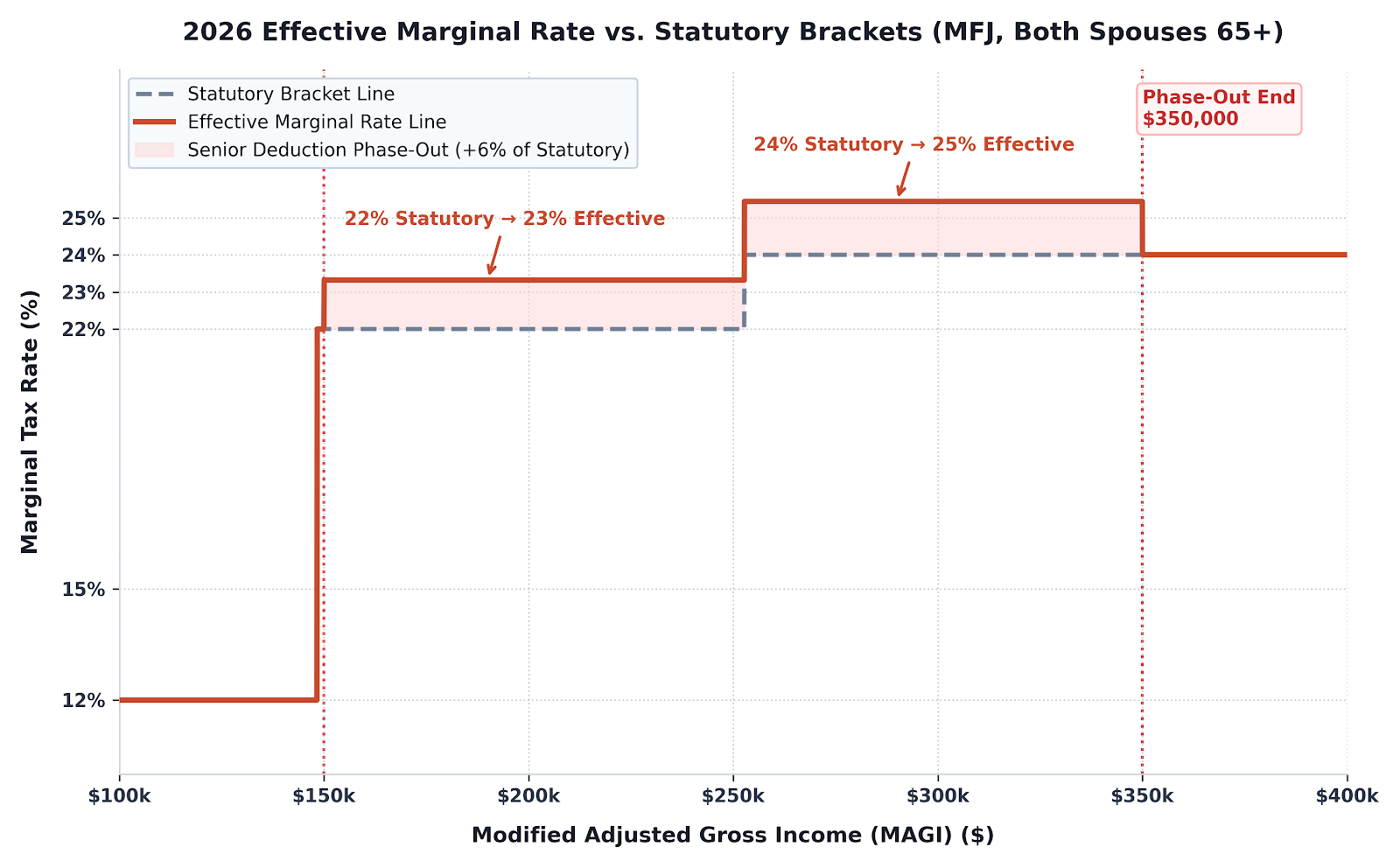
So the arithmetic behind “fill the bracket” is simple. If your taxable income this year lands at $70,000 and the 12% bracket runs to $100,800, you have about $30,800 of room. Convert that much and every dollar is taxed at 12%. Convert $40,000 and the last $9,200 is taxed at 22% instead, nearly double the rate on that slice.
That gap is real, and it’s why the advice exists. The trouble is that the bracket edge is the only fence most calculators can see.
What else reads your income
Your Medicare premium, two years later
If you’re 63 or older, this year’s income sets a Medicare premium you won’t pay until two years from now. The surcharge is called the Income-Related Monthly Adjustment Amount, or IRMAA, and it’s a cliff rather than a slope: one dollar over a threshold moves you into the next full tier.
For 2026, a couple filing jointly stays clear of it at or below $218,000 of modified adjusted gross income. One dollar above that costs each spouse $81.20 a month extra on Part B and $14.50 on Part D. If both are enrolled in Part B and a Part D plan for the full year, that’s about $2,297 across the year, for a single dollar of conversion.
That’s the whole subject of the two-year lookback post, including why the delay makes it so easy to trip.
How much of your Social Security is taxable
Social Security benefits aren’t taxed at a flat rate. How much of your benefit is included in your income depends on your “combined income”: half your benefits plus your other income, including tax-exempt interest. For a couple filing jointly, up to half the benefit becomes taxable above $32,000 of combined income, and up to 85% of it above $44,000.
Those thresholds are set in statute and are not adjusted for inflation. They’re fixed in statute at those figures and have never been adjusted. A conversion raises the income that feeds that calculation, which can drag more of your benefit into taxable income at the same time, so the effective rate on a conversion dollar can be higher than the bracket suggests.
A surtax on your investment income
The Net Investment Income Tax is 3.8% on investment income (interest, dividends, capital gains, rents) above a modified adjusted gross income of $250,000 for a couple filing jointly or $200,000 for a single filer. Like the Social Security thresholds, these aren’t indexed to inflation.
The conversion itself isn’t subject to it. Distributions from retirement accounts are specifically excluded from net investment income. But the conversion does raise your income, and if that pushes you over the threshold, your other investment income gets caught.
Your state
If you live somewhere with an income tax, your state is taxing the conversion too, in the year you do it. Top rates run from zero to 13.3%, and a handful of states treat retirement income, including conversions, very differently from the rest. This one is quietly the largest lever available to some people, and it’s almost never in the conversation.
The window most people are aiming at
Behind the sizing question is usually a timing one. Conversions tend to cluster in the years after you stop working and before two things switch on: Social Security, and required minimum distributions.
Required minimum distributions, or RMDs, are the withdrawals the IRS eventually makes you take from a traditional IRA or 401(k) whether you want the money or not. The current starting age is 73 for people born between 1951 and 1958, and 75 for those born in 1960 or later.
If you were born in 1959, the honest answer is that it isn’t settled. SECURE 2.0 was drafted with two clauses that point at different ages, the regulation is literally marked reserved on that cohort, and the IRS has proposed resolving it at 73 but hasn’t finalized it. If that’s your birth year, don’t build a plan on either number without checking where the rule landed.
Whichever it is, the shape is the same: once RMDs begin, a chunk of income arrives every year on a schedule you don’t control, stacked on top of Social Security. Converting before that happens is how people flatten their lifetime tax bill instead of front-loading their forties and back-loading their seventies. Roth IRAs have no required distributions during the owner’s lifetime, so what you convert stays out of that machine.

So what does “how much” actually depend on?
Six things, roughly in the order they matter:
- 01The gap between your rate now and your expected rate later. Converting only pays if you’re moving income from a higher-taxed year to a lower-taxed one. If you’ll be in the same bracket at 80 as you are at 63, the conversion mostly buys flexibility, not savings.
- 02How many years of window you have before Social Security and RMDs start filling the low brackets for you.
- 03Which threshold you hit first. Sometimes it’s the bracket edge. If you’re 63 or older, it’s often IRMAA, which sits at a different income level entirely.
- 04Where the tax money comes from. Paying the conversion tax out of a taxable account converts more per dollar of tax than paying it out of the converted amount. And if you’re under 59½, withholding from the conversion can trigger a penalty on the withheld portion.
- 05Your state, this year and next. A move across a state line changes the math more than most bracket decisions do.
- 06What you’re solving for. Lowest lifetime tax, largest inheritance, and lowest chance of running out are three different objectives, and they don’t always point at the same conversion.
And one thing that used to be on this list and isn’t anymore: you can’t undo it. Recharacterizing a conversion, unwinding it after the fact if the market moved against you, was eliminated for conversions made in 2018 and later. Once it’s done, it’s done for that tax year.
How we’d model this
No single rule here is complicated. Conversion sizing is hard because the rules interact, they interact across decades, and the answer depends on market returns you don’t get to know in advance.
That’s what Futurez is built for. The engine models federal brackets and the standard deduction, state income tax for 42 states individually, RMDs on the IRS uniform lifetime tables, Social Security including its taxability, and Medicare premiums with IRMAA brackets priced off income from two years earlier, the way the real rule works. It then runs the whole plan across 1,000 different market futures rather than one average one. (How we test that engine.)
You can write a conversion strategy as a rule that runs at the end of every simulated year, including bracket-aware ladders with helpers for how much room is left in a given bracket, and describe it in plain English rather than writing the logic yourself. Then save it as a version and change one thing. (Comparing saved versions side by side is a paid-plan feature.)
That lets you ask “what does converting $40,000 a year until 73 actually do to us, in the bad futures as well as the good ones?” and get an answer that puts the brackets, your state, required minimum distributions, Social Security taxability and the Medicare surcharge in one projection rather than one at a time. These are projections, not predictions.
See your own numbers
Build a plan, add a Roth conversion rule, and see what it does across 1,000 market futures. No signup needed to start.
Start ModelingFrequently asked questions
Is there an income limit on doing a Roth conversion?
No. The $100,000 income cap and the bar on married-filing-separately converters were repealed for tax years after 2009. Anyone can convert, at any income. You may still find an IRS regulation online that says otherwise. The second answer in 26 CFR 1.408A-4 still carries the old cap because it was never conformed to the 2005 law that removed it; the statute wins.
Can I undo a conversion if the market drops right after?
Not since 2018. The Tax Cuts and Jobs Act eliminated recharacterization for conversions. You can still recharacterize a regular annual contribution, but not a conversion.
Do I have to convert the whole account?
No. Conversions are partial by default in practice: you decide the amount, and most people convert a slice each year rather than the whole balance at once. Converting the whole thing in one year is usually the most expensive way to do it.
When does the 5-year rule bite?
There are two, and they're separate. One determines whether earnings come out tax-free: it starts on the first day of the tax year of your first Roth contribution or conversion, and it applies once per person across all your Roth IRAs. The other applies a 10% penalty to converted amounts withdrawn within five years of that particular conversion, and it runs separately for each conversion. If you're already past 59½, the second one isn't the binding constraint, because the penalty it enforces doesn't apply after that age.
Should I just convert up to the top of the 24% bracket every year?
Maybe, but check what else that income level touches before you commit to it. For a couple filing jointly, the 24% bracket runs to $403,550 in 2026, which is far above the first IRMAA threshold at $218,000 and above the Net Investment Income Tax threshold at $250,000. IRMAA will be binding long before the bracket edge is. Whether the investment surtax binds depends on how much investment income you have: it applies to the lesser of that income or the amount you're over the threshold, so someone whose money is all in retirement accounts can cross $250,000 and owe none of it.
Does a conversion count toward the Medicare surcharge income?
Yes. The taxable amount of a conversion is part of your adjusted gross income, and the income figure Medicare uses is built on adjusted gross income. It also isn't one of the eight life-changing events that let you ask Social Security to use a more recent year. That list is closed, and Social Security's guidance treats losses you chose, or ordinary investment risk, as outside it.
2026 brackets, standard deduction and additional standard deduction from IRS Revenue Procedure 2025-32 and the IRS 2026 inflation-adjustment release. The separate deduction for people 65 and over, and its 6% phase-out above $150,000 on a joint return, from 26 U.S.C. § 151(d)(5) and the IRS guidance on the enhanced deduction for seniors; the point at which it reaches zero is arithmetic from that formula. Retrieved August 30, 2026.
IRS Publication 915 and 26 U.S.C. § 86. The $25,000/$32,000 and $34,000/$44,000 thresholds are set in statute and are not indexed for inflation. Retrieved August 30, 2026.
IRS, “Questions and Answers on the Net Investment Income Tax,” and the Form 8960 instructions, which list qualified retirement plan distributions as excluded from net investment income. Thresholds are not indexed for inflation. Retrieved August 30, 2026.
IRS RMD FAQs and 26 CFR 1.401(a)(9)-2(b)(2). The 1959 birth year is marked reserved in the current regulation; IRS proposed regulations published July 19, 2024 would set it at 73, and were not final as of retrieval. Retrieved August 30, 2026.
IRS Publication 590-A, the IRS IRA FAQs, Form 8606 instructions, and 26 CFR 1.408A-4 and 1.408A-6 for the conversion and five-year rules. Retrieved August 30, 2026.
2026 premium and IRMAA figures from the CMS 2026 Medicare Parts A & B Premiums and Deductibles fact sheet and SSA POMS HI 01101.020. Retrieved August 30, 2026.
This page describes how tax rules interact; it isn’t tax advice, and the right answer depends on facts we don’t know about you. Futurez models the rules named above. Check anything that matters against a primary source or a professional before acting on it.