
Read enough about Roth conversions and you’ll notice something missing. Thread after thread works through bracket-filling, the timing of required minimum distributions, and whether to pay the tax from the conversion or from savings, and never mentions that a second government is also sending a bill.
For someone in a high-tax state, the state share can be significant on top of the federal cost. For someone in a no-tax state it’s nothing. If you itemize, part of that state bill comes back as a federal deduction, so the true gap between a high-tax and a no-tax state is narrower than the headline rates suggest. Narrower, not small.
The size of the lever
Top marginal state income tax rates for 2026, at the two ends and a few points between:
| State | Top marginal rate, 2026 |
|---|---|
| California | 13.3% |
| Hawaii | 11.0% |
| New York | 10.9% |
| New Jersey | 10.75% |
| Oregon | 9.9% |
| Massachusetts | 9.0% (5% plus a 4% surtax on income above a threshold) |
| Illinois | 4.95% (flat) |
| Pennsylvania | 3.07% (flat) |
| Arizona | 2.5% (flat) |
| Alaska, Florida, Nevada, New Hampshire, South Dakota, Tennessee, Texas, Washington, Wyoming | none on wage and ordinary income |
Nine states don’t tax wage or ordinary income. Two of those are recent: New Hampshire’s tax on interest and dividends was repealed for tax periods beginning after December 31, 2024, and Tennessee’s Hall income tax ended in 2021. Washington is the one that gets counted differently depending on who’s counting. It has no tax on wages or ordinary income but does tax large long-term capital gains, and retirement accounts are expressly exempt from that tax anyway.
Several states cut rates on January 1, 2026: Indiana to 2.95%, Kentucky to 3.50%, Mississippi to 4.00%, Montana to 5.65%, Nebraska to 4.55%, North Carolina to 3.99%, Ohio to a top rate of 2.75%, and Oklahoma to 4.50%.
The general rule: your state taxes in the year you convert
Most states build their income tax on top of your federal numbers: they start from federal adjusted gross income or federal taxable income and adjust from there. The taxable part of a Roth conversion is included in your federal gross income for the year you convert, so it flows straight into the state’s base.
California states the residency half of this rule plainly, in the course of explaining when it doesn’t apply:
“The taxable amount of a distribution from a traditional IRA (that is being converted to a Roth IRA in 2025) is included in your California source income only if you were a resident of California on the date of the distribution.”
That sentence appears under the Franchise Tax Board’s part-year resident guidance, which is where the date-of-distribution test gets spelled out most plainly.
Read the other way: if you were a resident, it is.
The states that don’t tax it
The nine with no income tax. Nothing to plan around. A conversion costs you the federal amount and nothing else.
Illinois. Illinois has a flat 4.95% income tax and subtracts federally taxed retirement income from it. Its retirement income publication lists individual retirement accounts and 401(k) plans among the qualifying sources, and names “converting a traditional IRA to a Roth IRA” in its list of required attachments. Only the federally taxed portion is subtractable, not the gross amount.
Pennsylvania. Pennsylvania’s Department of Revenue says it directly: “the conversion of a traditional IRA to a Roth IRA is generally not taxable.” Money moved from a traditional IRA to a Roth, by trustee-to-trustee transfer or by a rollover inside 60 days, isn’t subject to Pennsylvania income tax.
Two things go with that. Anything that leaves the traditional IRA and doesn’t land in the Roth is taxable in Pennsylvania, and the usual reason money doesn’t land there is that it was withheld to pay the federal bill. And when that happens, or when you convert only part of the account, your basis is split proportionally between the taxable piece and the untaxed conversion. So Pennsylvania gives you a second reason not to withhold from the conversion itself, on top of the federal one.
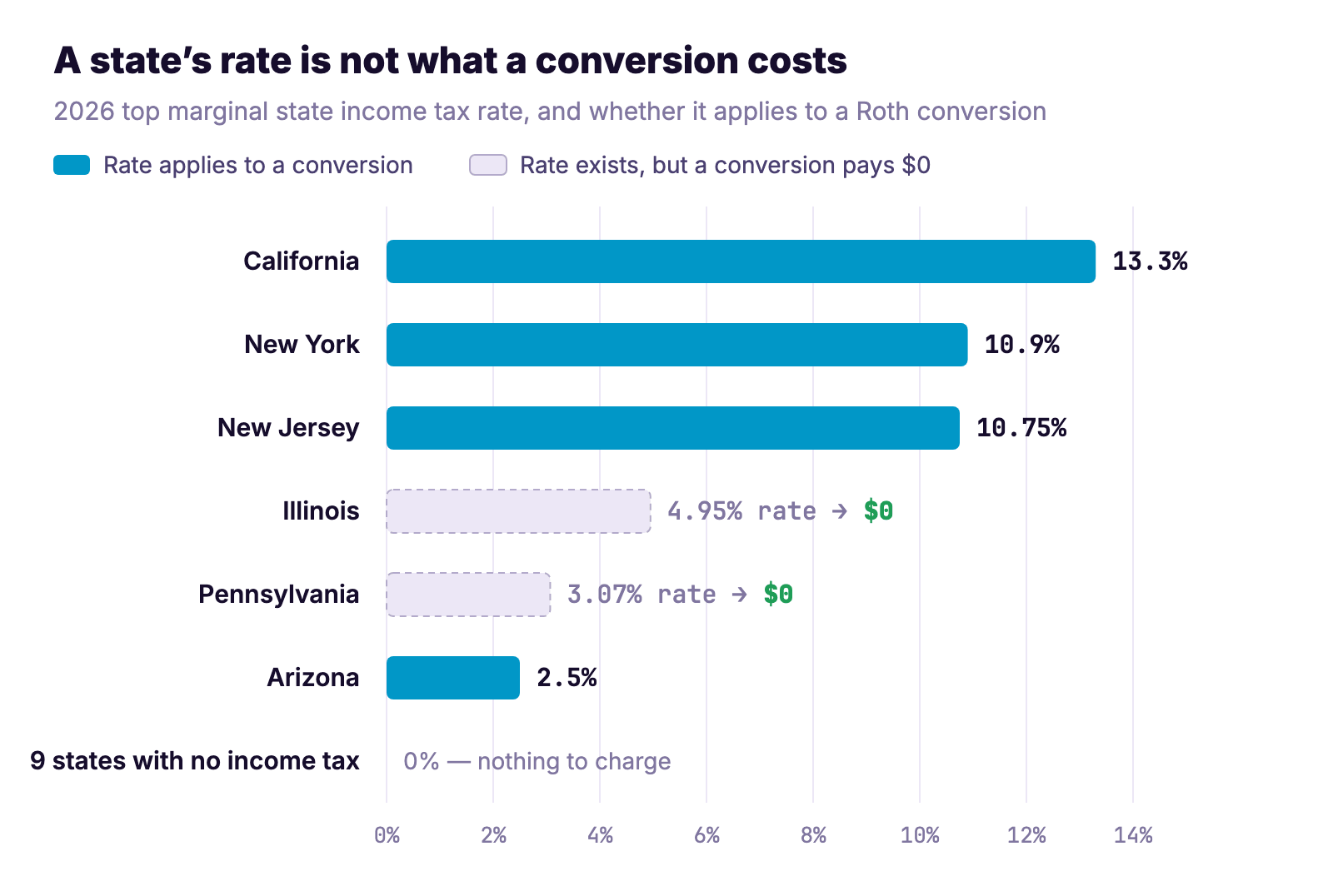
Illinois taxes income at a flat 4.95% and Pennsylvania at a flat 3.07%. On a $50,000 Roth conversion, both charge $0 in the ordinary case: Illinois by subtracting the retirement income, Pennsylvania by generally not treating the conversion as taxable at all. A flat rate tells you almost nothing about what a conversion costs there.
Iowa is the clearest case of the lot. Iowa has excluded retirement income from tax since 2023 for taxpayers who are 55 or older, disabled, or a surviving spouse, and its administrative rule doesn’t leave conversions to inference: the list of qualifying sources includes traditional individual retirement accounts, Roth individual retirement accounts, and, as its own line item, “Roth conversion income.” If you qualify on age or status, Iowa’s cost on a conversion is nothing. The exclusion is conditional on who you are rather than what you hold, so check that you meet one of the four conditions before planning around it.
Where your state’s basis differs from the federal one
A conversion isn’t always taxed on the same amount at the state level, because some states never gave you the deduction in the first place.
New Jersey doesn’t allow a deduction for contributions to a traditional IRA. So your New Jersey basis in the account is larger than your federal basis, and a proportional cost-recovery calculation applies, so the amount New Jersey taxes on a conversion is typically smaller than the amount the IRS taxes.
Massachusetts also gives you a larger state basis, for the same reason, but recovers it differently. Where New Jersey spreads your basis proportionally across every distribution, Massachusetts lets you take it first: nothing is taxed until the contributions Massachusetts already taxed have been fully recovered. On a partial conversion those two methods can produce very different bills, so don’t assume one state’s answer travels.
If you’ve lived in one of these states through your working life, the state bill on a conversion may be meaningfully lower than a naive percentage-of-the-conversion estimate suggests. It also means you need records going back a long way, which is its own argument for not leaving this to the year you do it.
Moving: what federal law protects, and what it doesn’t
This is where the lever is, and where people get overconfident.
Federal law does protect you once you’ve actually moved. Since 1996, 4 U.S.C. § 114 has said:
“No State may impose an income tax on any retirement income of an individual who is not a resident or domiciliary of such State (as determined under the laws of such State).”
That last parenthetical is the whole catch, and the next paragraphs are about it.
Individual retirement plans are explicitly on the list of covered plans. States used to chase former residents for tax on retirement income earned in-state, and California was the best-known example, which is why California’s own publication now says it doesn’t tax nonresidents’ retirement income received after December 31, 1995, and names Roth individual retirement accounts specifically in its list of covered plans.
What it doesn’t protect you from is still being a resident. Domicile isn’t changed by intent, and it isn’t changed by a mailing address. New York, for instance, treats you as a resident, regardless of domicile, if you keep a permanent place to live in the state for substantially all of the year and spend more than 183 days there.
So the fact pattern that fails is the obvious one: sell nothing, keep the apartment, “move” in December, convert in January, spend the summer back home. The protection in § 114 is real, and it starts when the move is real.
The honest version of this lever is that it’s worth a great deal to someone who was already going to move, and it’s a bad reason to move on its own. If a relocation is on the table anyway, the order of operations (move first, convert second) can be worth more than several years of careful bracket-filling.

Where this sits with everything else
State tax is one of the four things that move alongside your federal bracket when you convert: the Medicare surcharge two years later, how much of your Social Security becomes taxable, the surtax on your investment income, and your state. The sizing question is really the question of which of those you hit first.
State tax is the one most often left out, and it’s also the one with the biggest spread between the best and worst case.
Modeling it rather than estimating it
This gets left out because adding it by hand means tracking a second set of brackets, a second set of rules about what’s included, and a residency assumption that may change mid-plan, for every year of a thirty-year projection.
Futurez models state income tax for 42 states individually, plus configurable local tax, alongside federal brackets, required minimum distributions, Social Security and its taxability, and Medicare premiums with IRMAA brackets. So your state’s income tax is in the projection year by year, next to the federal bill, across 1,000 different market futures rather than a single average one. (How we test that engine.) The state-specific retirement exclusions above are worth confirming against your own state either way.
You can also model the move: build the plan one way, save it as a version, then change the state. (Comparing saved versions side by side is a paid-plan feature.) These are projections, not predictions.
See your own numbers
Price a conversion plan with your state's tax in it, and see what moving would actually be worth. No signup needed to start.
Start ModelingFrequently asked questions
Does my state tax a Roth conversion?
In most states, yes, as ordinary income in the year you convert, because most states start from your federal income. The exceptions are the nine states with no income tax, plus a small number that exempt retirement income. Illinois and Pennsylvania are the clearest cases.
Which state taxes it if I move during the year?
Generally the state you were a resident of on the date of the conversion. California states this explicitly, and it's the common rule. Part-year residency rules vary, so if you're converting in a year you move, that's a question for someone who knows your state.
Can my old state tax my conversion after I move away?
No. Federal law has prohibited states from taxing the retirement income of non-residents since 1996, and individual retirement accounts are covered. The catch is that you have to genuinely no longer be a resident. Several states have rules that keep you a resident based on days present and keeping a home there.
Is it worth moving to a no-tax state to convert?
On its own, almost never: the tax saved rarely justifies relocating a life. If you were already moving, the sequencing is worth real money, and moving before converting rather than after is the version that pays.
My state has a flat tax. Doesn't that make this simple?
Not necessarily. Illinois is flat at 4.95% and Pennsylvania is flat at 3.07%, and both charge nothing on a conversion. The rate tells you how income is taxed; it doesn't tell you what counts as income.
Does the state tax come out of the conversion?
Only if you have it withheld, and withholding from the conversion is usually the expensive choice: the withheld amount doesn't make it into the Roth account, and if you're under 59½ it can trigger a penalty on that portion. Paying from a taxable account converts more per dollar of tax.
Tax Foundation, “State Individual Income Tax Rates and Brackets, 2026” (updated February 19, 2026) and “2026 State Tax Changes.” Cross-checked at the high end against the Federation of Tax Administrators’ rate table. Retrieved August 30, 2026.
New Hampshire Department of Revenue Administration, “Repeal of NH Interest and Dividends Tax Now in Effect”; Tennessee Department of Revenue, “HIT-3 — Hall Income Tax Repealed Beginning January 1, 2021.” Retrieved August 30, 2026.
Washington Department of Revenue, capital gains tax pages, including the FAQ listing retirement accounts among exempt assets. Retrieved August 30, 2026.
Illinois Department of Revenue Publication 120, “Retirement Income” (revised 12/25). Retrieved August 30, 2026.
Pennsylvania Department of Revenue, Customer Service Center answer ID 274, “Taxability of Roth IRAs according to PA income tax rules,” updated August 14, 2026. Retrieved August 30, 2026.
Iowa Administrative Code rule 701—302.47 and Iowa Department of Revenue retirement income tax guidance. Retrieved August 30, 2026.
California Franchise Tax Board Publication 1005, “Pension and Annuity Guidelines.” Retrieved August 30, 2026.
New Jersey Division of Taxation Bulletin GIT-2, “IRA Withdrawals”; Massachusetts Department of Revenue Technical Information Release 10-8. Retrieved August 30, 2026.
4 U.S.C. § 114, enacted as Public Law 104-95 (January 10, 1996), effective for amounts received after December 31, 1995; New York 20 NYCRR § 105.20 for the statutory residency test. Retrieved August 30, 2026.
This page describes how state rules interact with a conversion; it isn’t tax advice, and state rules change more often than federal ones. Figures are 2026 amounts. Check anything that matters against your state’s department of revenue or a professional before acting on it.