
Most surprises in retirement planning are surprises of size. This one is a surprise of timing.
Medicare charges higher-income beneficiaries an extra monthly amount on top of the standard premium. It’s called the Income-Related Monthly Adjustment Amount, or IRMAA, and it’s set by the income on a tax return you filed two years earlier. So the bill arrives long after the decision that caused it.
For anyone doing Roth conversions in their sixties, that lag is the whole problem.
What IRMAA actually is
The standard Medicare Part B premium in 2026 is $202.90 a month, with a $283 annual deductible. That’s what most people pay. About 8% of Part B enrollees pay more, because their income was above a threshold.
The surcharge has two halves. One is added to your Part B premium. The other is added to whatever you pay for your Part D prescription drug plan. Part D IRMAA isn’t a total; it’s an amount stacked on top of your own plan’s premium.
Both are per person. A married couple who are both on Medicare and both over a threshold pay it twice.
The lag, precisely
Social Security sets your premium using the most recent tax information the IRS can give it. In practice that’s the return from two years before the premium year, so 2026 premiums are set by your 2024 income.
The official wording is worth reading exactly, because it has a wrinkle most summaries drop. From Social Security’s own operating manual:
If your two-year-old return isn’t available yet, they’ll use the three-year-old one. Form SSA-44 says the same thing from the other direction: they asked the IRS for your 2024 return, and if that wasn’t available, your 2023.
That fallback matters, and not only as trivia. Being billed off a three-year-old return is itself one of the grounds for asking for a fresh determination once the newer one exists.
The income figure they use is your adjusted gross income plus tax-exempt interest. Municipal bond interest doesn’t help you here. And the taxable part of a Roth conversion is part of your adjusted gross income, so a conversion feeds this number directly.

The 2026 thresholds
These are based on 2024 income. Note that the brackets are “greater than”: income of exactly $218,000 for a couple is in the zero tier.
| Single filer | Married filing jointly | Extra Part B / month | Total Part B / month | Extra Part D / month |
|---|---|---|---|---|
| $109,000 or less | $218,000 or less | $0 | $202.90 | $0 |
| Over $109,000 to $137,000 | Over $218,000 to $274,000 | $81.20 | $284.10 | $14.50 |
| Over $137,000 to $171,000 | Over $274,000 to $342,000 | $202.90 | $405.80 | $37.50 |
| Over $171,000 to $205,000 | Over $342,000 to $410,000 | $324.60 | $527.50 | $60.40 |
| Over $205,000, under $500,000 | Over $410,000, under $750,000 | $446.30 | $649.20 | $83.30 |
| $500,000 or more | $750,000 or more | $487.00 | $689.90 | $91.00 |
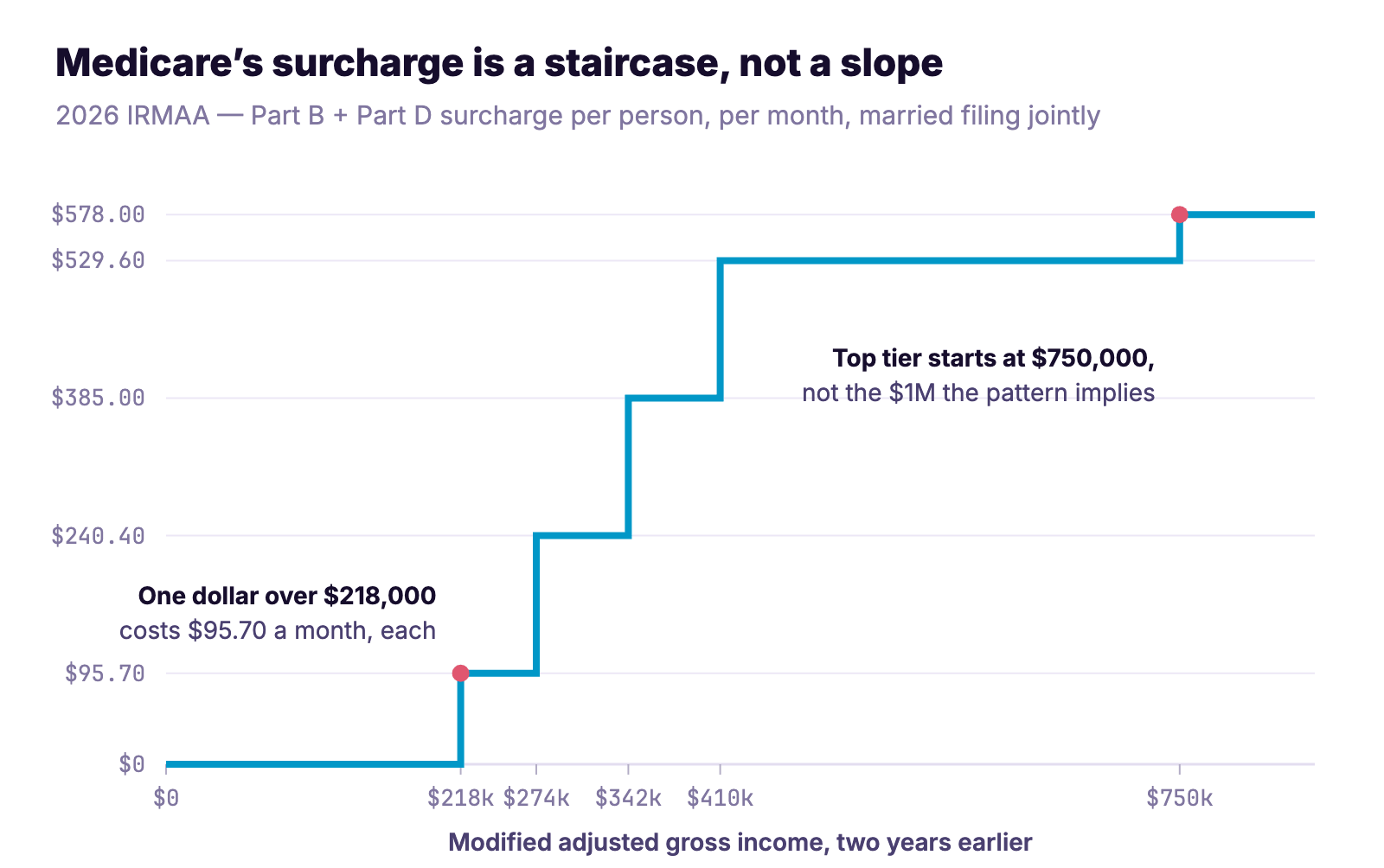
One oddity worth knowing if you’re building your own spreadsheet: every married-filing-jointly threshold is exactly double the single one except the top, which is $750,000 rather than $1,000,000. It’s an easy row to get wrong by assuming the pattern holds.
Married filing separately has its own three-tier schedule, and it’s punishing: the second tier starts at $109,000 and jumps straight to the $446.30 surcharge. Its top tier begins at $391,000, which is the same pattern break again, in the schedule you’d least want to guess at.
It’s a cliff
There’s no phase-in. Each income range maps to one flat surcharge, and crossing into the next range applies the whole thing.
What one dollar can cost. A couple filing jointly with 2024 income of $218,001, one dollar over the first threshold, each pay $81.20 more a month for Part B and $14.50 more for Part D. If both are enrolled in Part B and a Part D plan for the full year, that’s about $2,297 across the year for that single dollar.
Which means the last dollar of a conversion that lands just past a threshold can carry an effective tax rate in the hundreds of thousands of percent. That’s a silly way to say it, and it’s also the correct intuition: near a threshold, the marginal cost of one more dollar of conversion has nothing to do with your tax bracket.
The part that catches people: the tail
The shape of it is worth walking through.
IRMAA only applies once you’re actually enrolled in Medicare, which for most people is at 65. It’s enrollment that matters rather than age, so someone who came onto Medicare early through disability or end-stage renal disease is exposed sooner. But it’s set by income from two years earlier. So, for the typical case:
- The first year your conversions can bite is 65, set by your income at 63. If you started converting at 62 or 63 because you’d just retired and your income had dropped, you were in the clear for two years, then the bill showed up.
- The last year they bite is two years after you stop. Finish your last conversion at 70, and you’re still paying the surcharge at 71 and 72, on income you no longer have.
That two-year tail is the part that gets left out of most conversion math. People model the income tax on the conversion, which is a same-year cost, and quietly assume every other consequence behaves the same way. It doesn’t.
It also means that if you’re planning conversions and you’re 63 or older, the binding constraint is often IRMAA rather than your tax bracket, and the two sit at completely different income levels. For a couple filing jointly in 2026, the 24% bracket runs to $403,550, while the first IRMAA threshold is at $218,000.
What you can do about it
Plan around it, mostly. The realistic levers are the ones you pull before the income happens: size conversions to land under a threshold rather than just past one, do the aggressive years before you turn 63, and remember that both spouses’ premiums move together. Sizing a conversion well also means knowing what your state charges on it, which varies more than most people expect.
Ask for a new determination, if you qualify. Social Security can use a more recent year instead, for eight specific life-changing events. You have to ask and document it; nothing happens automatically. The eight are: marriage, divorce or annulment, death of a spouse, work stoppage, work reduction, loss of income-producing property, loss of pension income, and an employer settlement payment. You request it on Form SSA-44.
A Roth conversion is not on that list. No official document says “a conversion doesn’t count,” so you’ll see people argue it. But the list is closed, and Social Security’s own guidance on the nearest category is explicit that a loss you chose, whether by gift, sale or transfer, isn’t beyond your control, and that ordinary investment risk is taken at your direction. A conversion is voluntary and raises income rather than lowering it, so there’s no door for it.
There is a separate route worth knowing. Beyond life-changing events, you can request a new initial determination if you amended your return, if the IRS information was wrong, if they used a three-year-old return when the two-year-old one now exists, or if you filed married-filing-separately and your living arrangement changed. That’s not an appeal; it’s a fresh decision, and it doesn’t require overturning the old one. You can do both at once if you’re inside the appeal window.
Modeling it instead of remembering it
This rule is easy to understand and hard to hold. It operates on a two-year delay, in a different dimension from tax brackets, across both spouses, over a decade of decisions where the right move in one year depends on what you did two years before. Tracking that by hand is where it goes wrong.
Futurez models that lookback. The surcharge lands two years after the income that triggered it, which is what makes a conversion at 63 show up as a higher premium at 65. It sits alongside federal brackets, state income tax for 42 states, required minimum distributions, and Social Security including its taxability, and the whole plan runs across 1,000 different market futures rather than one average one, because the balance you’re converting from isn’t a straight line either. (How we test that engine.)
One limit worth knowing, given what’s above: the engine builds that income figure from adjusted gross income and doesn’t add tax-exempt interest back on top the way the real rule does. If a meaningful share of your income is municipal bond interest, the surcharge in your plan will read low.
So you can write a conversion rule, run it, and see the surcharge land in the years it actually lands. These are projections, not predictions.
See your own numbers
Model a conversion plan and see the surcharge land two years later, where it belongs. No signup needed to start.
Start ModelingFrequently asked questions
Does a Roth conversion count toward IRMAA income?
Yes. The taxable amount of a conversion is included in your adjusted gross income, and the figure Social Security uses is adjusted gross income plus tax-exempt interest. There's no carve-out for conversions.
Which year's income sets my 2026 premium?
Your 2024 income, in almost every case. If your 2024 return wasn't available to the IRS when Social Security asked, they use 2023, and once 2024 exists, that's grounds to ask them to redo it.
Is IRMAA phased in, or is it a cliff?
A cliff. Each income range carries one flat surcharge, and one dollar into the next range applies that range's full amount. There's no proration anywhere in the rule.
Can I appeal an IRMAA determination because of a Roth conversion?
Not on the strength of the conversion itself. The list of eight is closed, and Social Security's guidance treats a loss you chose, or ordinary investment risk, as outside it. A conversion is voluntary and raises income rather than lowering it. You can still appeal for other reasons: wrong data, an amended return, a genuine life-changing event that also happened.
Does it apply to both spouses?
Yes, if both are on Medicare. The determination is made on the household's reported income and the surcharge is charged to each enrolled person, so a couple pays it twice.
Can I avoid it by holding municipal bonds?
No. Tax-exempt interest is added back explicitly. Munis keep the interest out of your taxable income but not out of the income figure Medicare uses.
What if I convert before I'm on Medicare?
If neither of you is enrolled in Medicare yet, income from before 63 has no surcharge year to land in, which is why the early-sixties window is worth more than it looks. Two caveats. It's enrollment that triggers the surcharge rather than turning 65, so anyone on Medicare early through disability or end-stage renal disease is exposed earlier. And in a couple with an age gap, a joint return is a joint return: the older spouse's premium at 65 is set by the household's income two years before, whoever earned it.
2026 Part B premium, deductible, and the full IRMAA bracket table from the CMS fact sheet “2026 Medicare Parts A & B Premiums and Deductibles” (published November 14, 2025) and SSA POMS HI 01101.020, which agree exactly. Retrieved August 30, 2026.
SSA POMS HI 01101.010 and Form SSA-44 (12-2025). The quoted sentence is from POMS HI 01101.010. Retrieved August 30, 2026.
20 CFR 418.1010 gives the full statutory list; SSA POMS HI 01101.010 describes the practical computation as adjusted gross income plus tax-exempt interest. Both are official; the regulation is broader than the operating manual’s summary. Retrieved August 30, 2026.
20 CFR 418.1120, which assigns each income range a single flat beneficiary percentage with no proration term. Retrieved August 30, 2026.
Form SSA-44, SSA POMS HI 01120.001 and HI 01120.035. Retrieved August 30, 2026.
IRS, Retirement Plans FAQs Regarding IRAs, and 26 CFR 1.408A-4. Retrieved August 30, 2026.
This page describes how the rule works; it isn’t tax advice, and the right answer depends on facts we don’t know about you. Figures are 2026 amounts and change annually. Check anything that matters against Medicare.gov or Social Security directly before acting on it.